Liza Choa
Quick answer
Can a dental AI receptionist book patients without a practice management system integration?
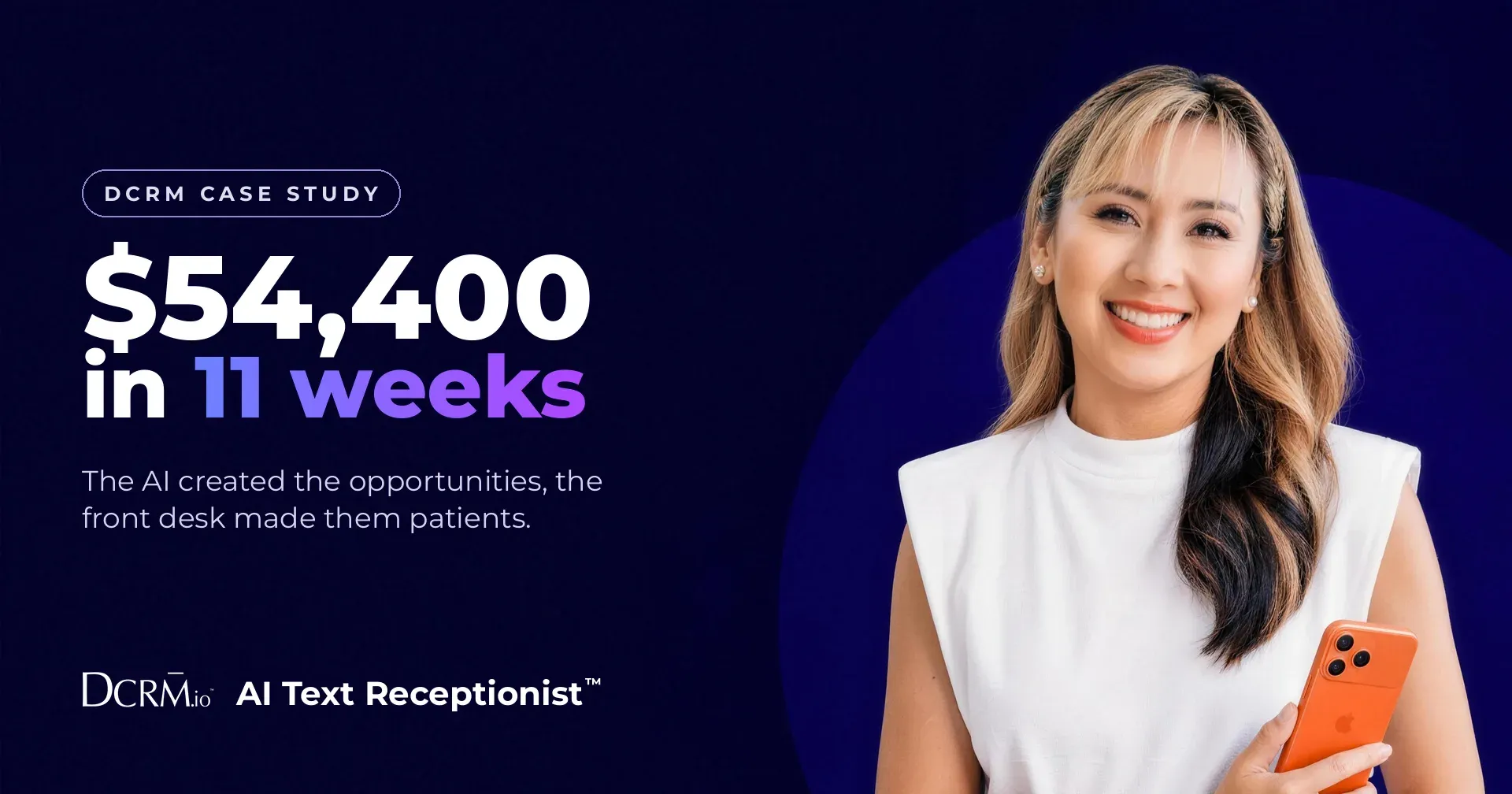
No, and it does not need to. Without an integration it answers the patient’s text, works out which treatment they want, and creates an opportunity for the front desk with a callback time on it. In this practice that produced 47 warm cards and $54,400 of booked treatment in 11 weeks.
An inner Sydney cosmetic practice booked A$54,400 of treatment in 11 weeks from people who had done nothing more than download a lead magnet.
243 people downloaded it. The follow-up text went out to all of them asking how they went with it and whether they would like to make an appointment. 51 responded. The DCRM AI Text Receptionist™, a dental AI receptionist that answers patient texts, picked up 48 of those 51 conversations.
AND… it did not book a single one of them.
That was never its job. For this practice, the practice management system (PMS) was not integrated with DCRM, so the AI Text Receptionist couldn’t do the booking.
Instead, it did what it was designed to do: follow our proprietary AAA formula and guide the prospect along the patient buying journey, from lead to enquiry. It chatted with the prospect, it worked out what the person actually wanted, and got them to say “yes” to a call.
Then it created an opportunity in the SmileEngine™ Pipeline for the front desk team to book the patient in! 47 cards landed that way. The front desk then rang those people and booked them in.
Now… the treatment value is not the only interesting part. The interesting part is when those conversations happened. Replies landed at 8pm, at 11:40pm and at 5 past midnight, and every one of them was answered within 40 seconds, with nobody at the practice.
The practice is a single site, cosmetic-led, busy on the phones, working across general dentistry, cosmetic work, orthodontics and implants. Its patients are professionals who research before they enquire. Exactly the kind of person who downloads a price list at 11 o’clock at night and then goes quiet.
Before this, that person got an answer at 8:30am the next morning. By then they had rung somebody else.
Who did what
| Step | Who | Count |
|---|---|---|
| Price list sent, follow-up text sent | DCRM automation | 243 |
| Patient wrote back | The patient | 51 |
| Conversation answered and qualified | AI Text Receptionist | 48 |
| Opportunity created with treatment and callback time | AI Text Receptionist | 47 |
| Patient rung and booked in | The front desk | $54,400 booked in |
Frequently asked questions
What does a dental AI receptionist actually do?
It answers patient texts the moment they arrive, works out which treatment the patient wants and whether they would like a call, then creates an opportunity for the front desk with those details on it.
Does a dental AI receptionist book the appointment itself?
Not without an integration into the practice management system. It qualifies the enquiry and hands it over, and a person at the practice makes the call and books the patient in.
How quickly does it answer a patient text?
In this practice, between 18 and 40 seconds, at any hour, including weekends and the middle of the night.
Does the AI quote prices to patients?
No. It points people to the price list and hands anything specific to the team. That keeps you on the right side of AHPRA and stops patients being quoted a number nobody at the practice has agreed to.
What happens to a patient who replies stop?
They come out of the sequence straight away.
What does the front desk have to do?
Keep an eye on the pipeline and ring the people the AI has lined up, with the treatment and the preferred time already on the card. That call is where the booking happens.

Written by
Liza Choa
Liza Choa is the founder of DCRM and Practice Growth Studio, a boutique dental marketing agency working behind the scenes with some of the most respected dental practices in Australia. She has spent over a decade helping practices grow and scale.
She built DCRM after seeing the same problem in practice after practice. The enquiries were already there, but the new patient numbers did not reflect it. DCRM bridges that gap, so practices increase the return on the marketing they are already paying for.
Disclaimer: The figures in this case study reflect the results of one dental practice over a defined period, and were taken from that practice’s DCRM account at the date stated. The practice is not identified, and identifying details have been removed or generalised. Results vary between practices and depend on factors outside the platform, including enquiry volume, treatment mix, pricing, location, team capacity and how consistently the practice follows up. These figures are not a prediction, projection or guarantee of the results any other practice will achieve. Data is reported as recorded in the platform and has not been independently audited. No patient information is disclosed.