Liza Choa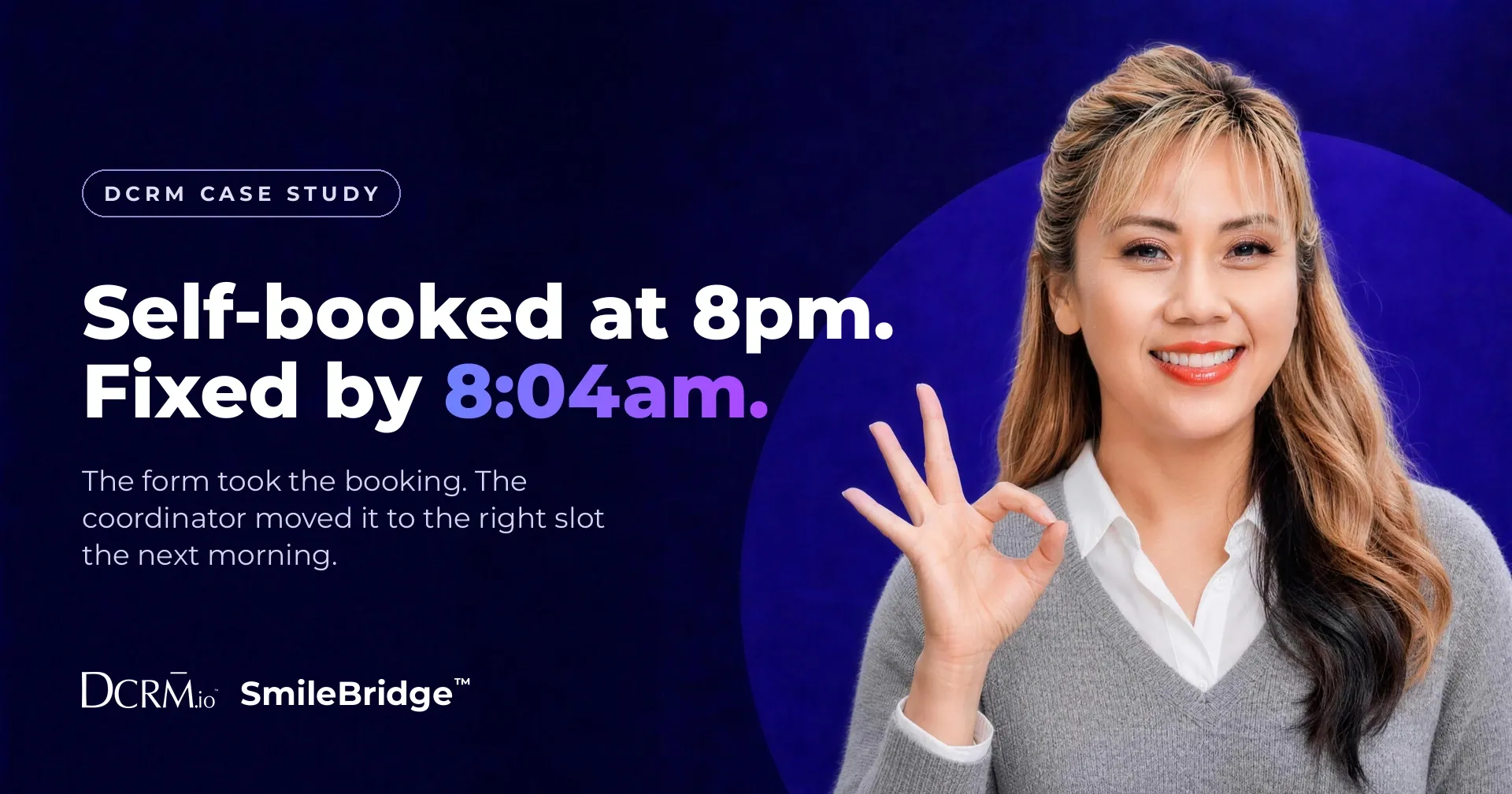
Quick answer
What happens when a patient self-books the wrong dental appointment slot?
Somebody at the practice fixes it. At one practice a patient self-booked at 8pm into a short emergency slot for a new patient exam, x-rays and a clean. The coordinator spotted it at 8:04 the next morning, texted the patient, and had them rebooked into a proper appointment by 8:25.
A prospective patient came off a Facebook link at 7:54 on a Monday evening, asked 1 question, and had booked themselves an appointment through SmileBridge™ by 8:00pm. 6 minutes and 15 seconds, nobody at the practice awake.
At 8:04 the next morning the coordinator opened it, saw the booking was in the wrong slot, and undid it.
That is not a failure of the system. That is the system doing exactly what it is supposed to do, and it is the most useful case study in this whole set.
The numbers
- From the enquiry to a self-booking
- 6minutes
- Of texting to fix it the next morning
- 21minutes
- Messages from a human, all the next morning
- 4
- Monday 14 September, 7:54pmEnquiry arrived
- 7:55pmQuestion asked, and the booking link sent
- 8:00pmSelf-booked, 6 minutes 15 seconds after the enquiry
- Tuesday 15 September, 8:04amThe coordinator opened it
- 8:25amRebooked correctly
The 6 minutes
1 question, 1 link, 1 confirmation. Done in 6 minutes on a Monday night.
What the coordinator found at 8:04 the next morning
The 10am slot on 21 September was an emergency slot. Short, meant for someone in pain. This patient wanted a comprehensive exam, 2 x-rays and a clean, which needs a proper appointment.
The patient replied at 8:09. By 8:16 they had been offered 2:50pm the same day with a different dentist. By 8:25 it was rebooked, with the date of birth taken to finish the patient file.
In plain English
Left alone, that 8pm booking would have gone wrong. The patient would have turned up on 21 September expecting an exam, x-rays and a clean, into a slot with a fraction of the time needed for it. Somebody would have had to have an awkward conversation in the waiting room.
Instead the awkward conversation happened by text at 8:04 the next morning, before anybody had rearranged their day.
The self-booking got the patient into the system at 8pm. The coordinator got them into the right appointment at 8:25.
Neither of those 2 things works without the other.
Frequently asked questions
Did the self-booking stick?
Not as made. It was rebooked the next morning to a longer slot with a different dentist, which was the right outcome.
Is a booking in the wrong slot a problem with the form?
It is a problem with which slots were open to it. The form can only offer what you release.
How long did the fix take?
21 minutes of texting, from 8:04 to 8:25 the next morning.
Why is there no dollar value on the 8pm booking?
Because the opportunity carries no value. It is a new patient package, and I am not going to invent a figure for it.
Does the CRM record now match reality?
No. The record still shows the original time and dentist. That is worth fixing before anyone reports on it.

Written by
Liza Choa
Liza Choa is the founder of DCRM and Practice Growth Studio, a boutique dental marketing agency working behind the scenes with some of the most respected dental practices in Australia. She has spent over a decade helping practices grow and scale.
She built DCRM after seeing the same problem in practice after practice. The enquiries were already there, but the new patient numbers did not reflect it. DCRM bridges that gap, so practices increase the return on the marketing they are already paying for.
Disclaimer: The figures in this case study reflect the results of one dental practice over a defined period, and were taken from that practice’s DCRM account at the date stated. The practice is not identified, and identifying details have been removed or generalised. Results vary between practices and depend on factors outside the platform, including enquiry volume, treatment mix, pricing, location, team capacity and how consistently the practice follows up. These figures are not a prediction, projection or guarantee of the results any other practice will achieve. Data is reported as recorded in the platform and has not been independently audited. No patient information is disclosed.