Liza Choa
Quick answer
Do dental patients book online after hours if you let them?
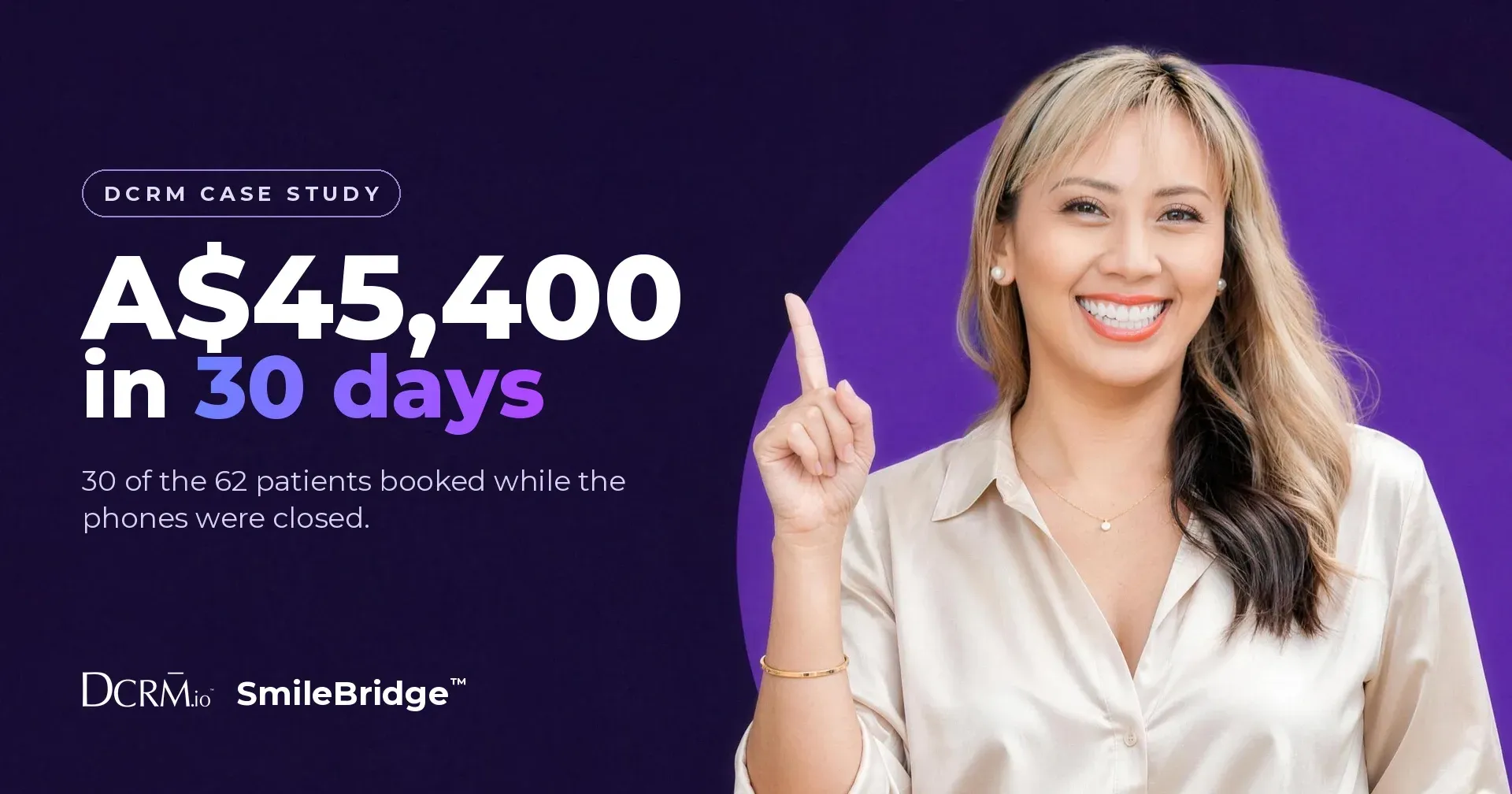
Yes. At 1 Melbourne practice, 62 patients booked themselves through the website in September 2026, carrying A$45,400 of treatment. 30 of them booked while the phones were closed, including 10 between 8pm and 6am. None of the 62 needed a call or message from the practice to book.
A$45,400 of treatment went into the books at a Melbourne practice in September, and nobody at the front desk made a single one of those bookings. 62 people found SmileBridge™, the practice's dental online booking form, picked a time and booked themselves straight into the calendar. 30 of them did it after the phones had closed.
It is the same practice that booked $24,300 in its first 11 days. September was its first full month.
The A$45,400 is not the part I want you to look at. Look at the clock.
The numbers
| September 2026 | Figure |
|---|---|
| People who booked themselves online | 62 |
| Treatment value booked | A$45,400 |
| Booked outside opening hours | 30 people, A$11,800 |
| Booked on a Saturday or Sunday | 16 |
| Booked between 8:00 PM and 6:00 AM | 10 |
| Emergency patients who booked themselves | 25, 14 of them outside business hours |
| Share of all pipeline bookings made by the patient | 71 of 98 (72%) |
| Messages or calls from the practice needed to book them | 0 |
What the clock says
Here are 3 of the 30.
- Saturday, 2:02amA hole where a filling used to be
- Tuesday, 10:08pmA filling gone
- Sunday afternoonA wisdom tooth consultation
Not one of these people waited for a call back. They chose a time, the booking went straight into the practice software, and the card in DCRM™ moved to Booked In on its own. By the time the front desk arrived the next working morning, every one of them was already in the books.
25 emergency patients booked themselves this way in September. 14 of them did it while the phones were closed.
In plain English
I want you to think about who books at 9pm. It is the person with a sore tooth who finally has the kids in bed.
If your website says "call us tomorrow", some of them will. Many will not. Some will book whichever practice lets them do it right now. That is the whole case for dental online booking after hours.
Now... the phones at this practice are already open for longer hours. Early starts on weekdays, Saturdays until 4pm. And still, nearly half the people who booked themselves did it outside those hours. Patients book when it suits them, not when the phones are staffed.
And the front desk? This is my favourite part. Their call back list got shorter. 70 enquiries in September still needed a person, and those are the conversations worth a person's time.
The automation is there to cover off speed. Your team is there for the relationship and to build trust. They complement each other beautifully!
Frequently asked questions
Did the front desk make any of the 62 online bookings?
No. Every one of the 62 bookings was made by the patient on the practice website, straight into the practice management system, with no call or message from the practice. The front desk spent September on the 70 enquiries that still needed a conversation.
How soon did dental online booking start working after go-live?
Within hours. The practice switched SmileBridge on 21 August 2026, and the first patients booked themselves within hours of go-live. September 2026 was the first full month, and 62 patients booked themselves online in it.
Does online self-booking take work away from the front desk?
No. In September 2026, 70 enquiries at this practice still needed a conversation with a person, and the front desk handled those. The 62 patients who booked themselves simply came off the call back list.
How was the A$45,400 of treatment value worked out?
Each patient was counted once, at their highest-value treatment, using a standard case value: A$7,000 for orthodontics, A$2,000 for restorative, A$500 for an emergency and A$300 for general care. 3 orthodontic, 1 restorative, 25 emergency and 33 general patients add up to A$45,400.

Written by
Liza Choa
Liza Choa is the founder of DCRM and Practice Growth Studio, a boutique dental marketing agency working behind the scenes with some of the most respected dental practices in Australia. She has spent over a decade helping practices grow and scale.
She built DCRM after seeing the same problem in practice after practice. The enquiries were already there, but the new patient numbers did not reflect it. DCRM bridges that gap, so practices increase the return on the marketing they are already paying for.
Disclaimer: The figures in this case study reflect the results of one dental practice over a defined period, and were taken from that practice’s DCRM account at the date stated. The practice is not identified, and identifying details have been removed or generalised. Results vary between practices and depend on factors outside the platform, including enquiry volume, treatment mix, pricing, location, team capacity and how consistently the practice follows up. These figures are not a prediction, projection or guarantee of the results any other practice will achieve. Data is reported as recorded in the platform and has not been independently audited. No patient information is disclosed.