Liza Choa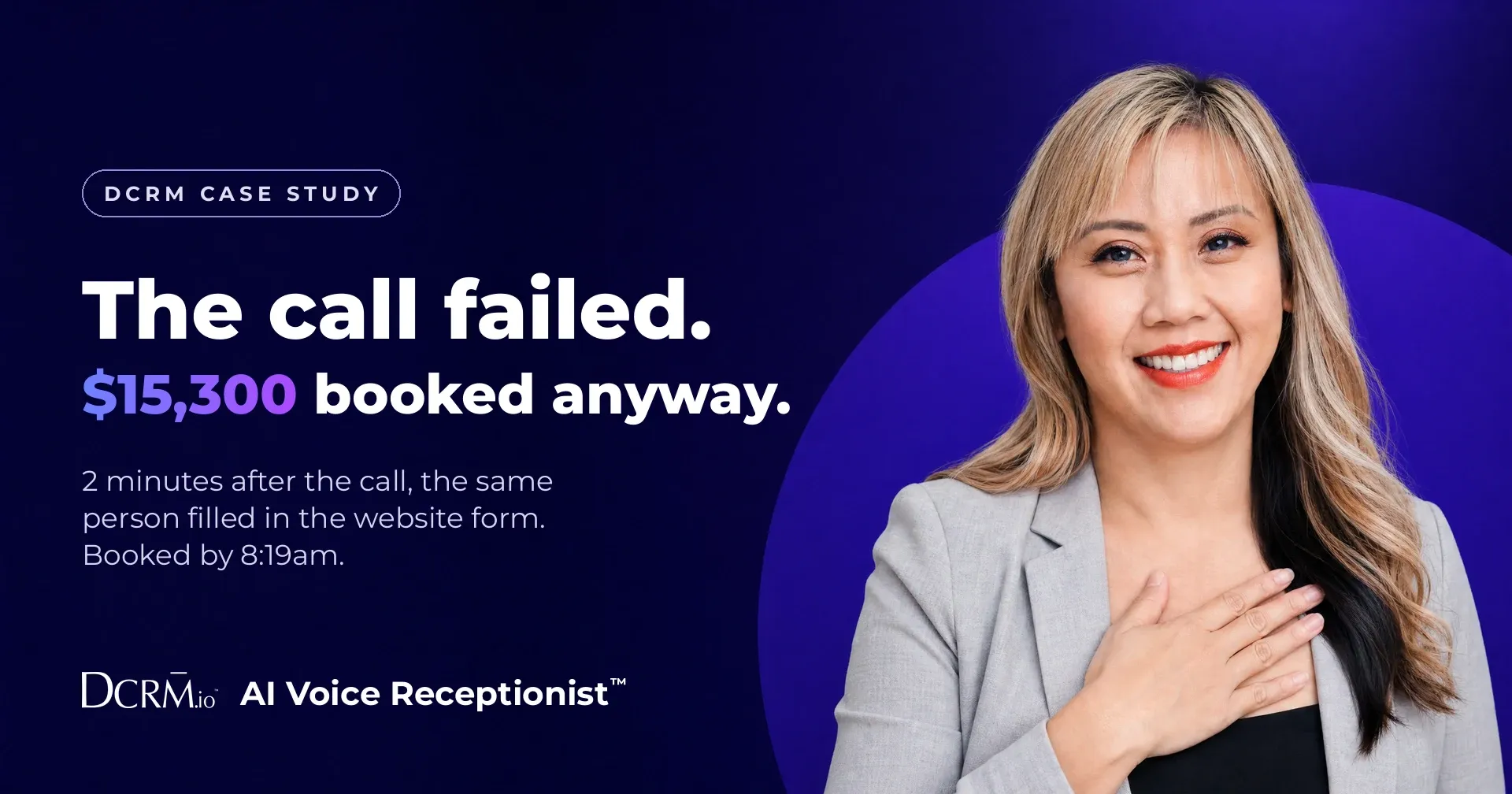
Quick answer
What happens when an AI voice receptionist cannot understand a caller?
At one practice it could not make out a word, so it promised a callback and ended the call. 2 minutes later the same person filled in the website enquiry form, ticking 3 treatments, and $15,300 of work was booked by 8:19am, before the practice opened.
At 7:49 on a Wednesday morning somebody rang the practice and the AI Voice Receptionist™ could not understand a single word they said. It got the name wrong as well.
3 minutes later the same person was on the website filling in the enquiry form. By 8:19 there was $15,300 of cosmetic, general and implant work booked in, and the practice had not opened yet.
I am writing this one up because the AI failed and it still worked out, and the reason why is the only bit that matters.
- On a call the AI could not understand
- 60seconds
- Until the same person filled in the website form
- 2minutes
- Booked by 8:19am
- $15,300
The timeline
- 7:49amInbound call. The AI voice receptionist answers. 60 seconds
- 7:50amCaller says “call me back”. The AI confirms a callback and ends the call
- 7:52amThe same person opens the website and fills in the enquiry form
- 7:52amOpportunity created, valued at $15,300 from the 3 treatments ticked on the form
- 7:53am3 automatic texts go out, the last with a booking link
- 7:53amPatient replies asking for a same-day appointment
- 7:54amPatient: “I’m free asap please just call when you’s can”
- 8:19amMoved to Booked In
- 8:20amCoordinator writes the note: booked a smile makeover
The practice opens at 8:30.
The call, word for word
This is the transcript. It is not flattering and I am not going to tidy it up.
60 seconds. Nothing usable. The caller is not called Jamie.
Then they went to the website
At 7:52, 2 minutes after hanging up, the enquiry form, a SmileEngine™ Form, came through from the home page. This is what it carried:
Everything the call failed to get, the form got in one go. The 3 treatment boxes are where the $15,300 comes from, because the system values each treatment off the case value table and adds them up.
| Treatment ticked | Case value |
|---|---|
| Cosmetic dentistry | $10,000 |
| Implants | $5,000 |
| General dentistry | $300 |
| All 3 | $15,300 |
And look at the last 5 words. “Could yous please call me”. They asked for a call twice, on 2 different channels, inside 3 minutes. That is somebody who really wants to be rung.
In plain English
The honest reading of this is not that the AI saved the day. It did not.
What happened is that a patient with a bad phone line tried the front door, could not get in, and went round to the side door 2 minutes later. Both doors were open at 7:50 in the morning, which is the whole point.
The AI voice receptionist contributed 2 real things. It answered a call at 7:49 that would otherwise have rung out. And 3 minutes later it sent an SMS saying the team would be in touch, which meant the practice’s number was already in that person’s phone.
The form did the rest.
Frequently asked questions
Did the AI voice receptionist book this patient?
No. It answered a call it could not understand, captured the number and promised a callback. The website form captured the detail and the booking followed.
Where did the $15,300 come from?
The patient ticked general dentistry, cosmetic dentistry and implants on the enquiry form. The system valued each against the case value table and added them up.
What time is the appointment?
It is not in the CRM. The coordinator’s note says a smile makeover was booked. The appointment itself sits in the practice management system and did not sync back.
Does the AI voice receptionist say it is an AI?
It does not claim to be a person, and when it cannot help it says so and offers the team, which is exactly what happened here.
Is the $15,300 money received?
No. It is the case value of the 3 treatments selected, which is what the booking is worth to the practice if it proceeds.

Written by
Liza Choa
Liza Choa is the founder of DCRM and Practice Growth Studio, a boutique dental marketing agency working behind the scenes with some of the most respected dental practices in Australia. She has spent over a decade helping practices grow and scale.
She built DCRM after seeing the same problem in practice after practice. The enquiries were already there, but the new patient numbers did not reflect it. DCRM bridges that gap, so practices increase the return on the marketing they are already paying for.
Disclaimer: The figures in this case study reflect the results of one dental practice over a defined period, and were taken from that practice’s DCRM account at the date stated. The practice is not identified, and identifying details have been removed or generalised. Results vary between practices and depend on factors outside the platform, including enquiry volume, treatment mix, pricing, location, team capacity and how consistently the practice follows up. These figures are not a prediction, projection or guarantee of the results any other practice will achieve. Data is reported as recorded in the platform and has not been independently audited. No patient information is disclosed.