Liza Choa
Quick answer
Can an AI voice receptionist reduce dental missed calls?
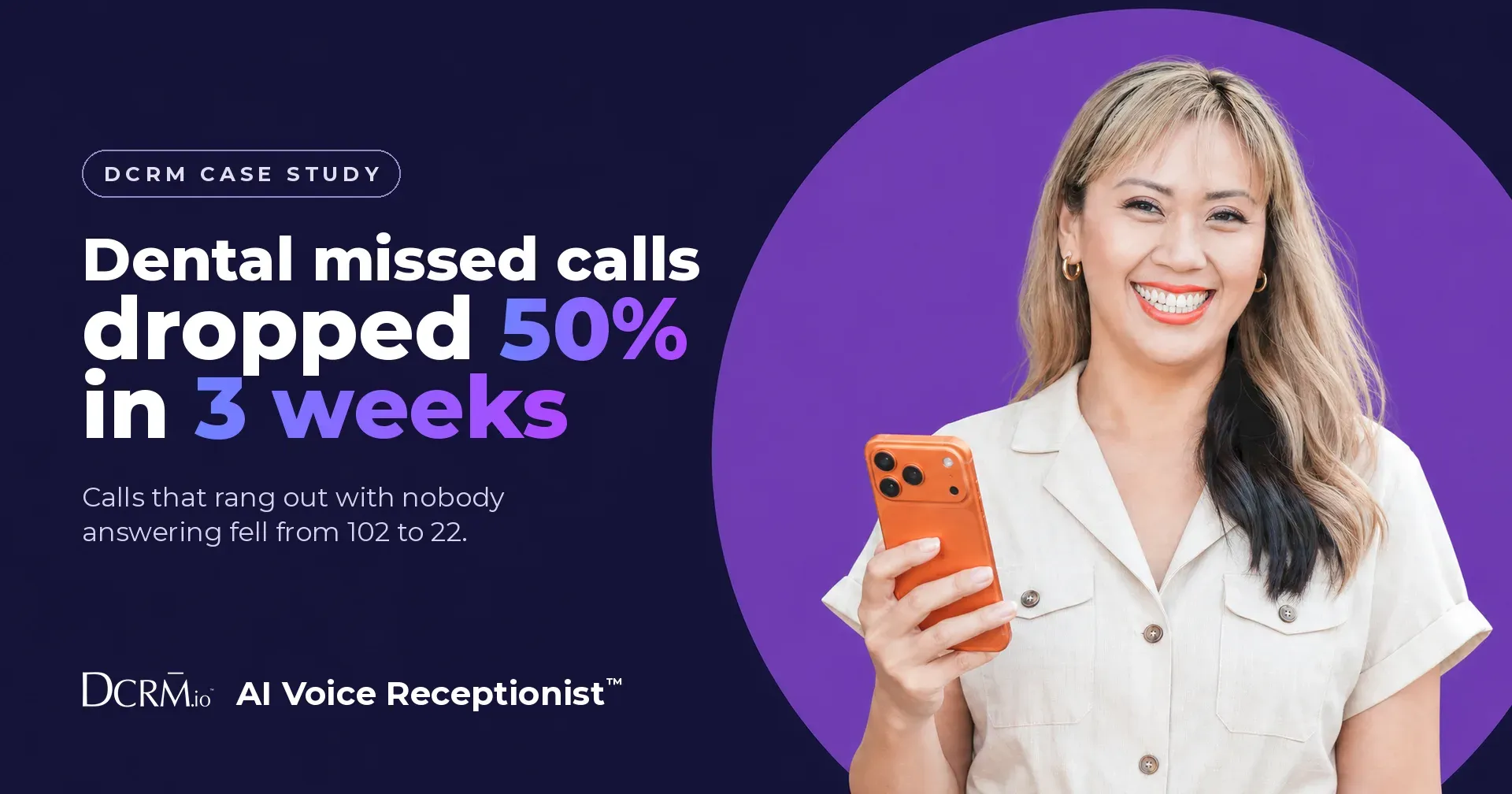
Yes. A general practice in outer Melbourne switched the AI Voice Receptionist™ on during opening hours. Missed calls halved, from 167 to 84. Calls that rang out with nobody answering fell from 102 to 22. The AI took 162 calls the team could not get to.
The scene
A long-established general practice in outer Melbourne had a problem most busy practices share. When the front desk was with patients, the phone rang out. About 1 in 7 calls went unanswered. That is what dental missed calls look like at a busy practice.
On 10 September they switched the DCRM AI Voice Receptionist™ on during opening hours. Now, when the team cannot get to the phone, the AI picks up.
I compared the 3 weeks before with the 3 weeks after, straight from the practice phone dashboard. Same practice. Same phone line. Same days of the week. Here is what happened.
The numbers
| All calls, practice line | 3 weeks before (20 Aug to 9 Sep) | 3 weeks after (10 to 30 Sep) |
|---|---|---|
| Calls in | 1,096 | 1,025 |
| Answered by the team | 929 | 779 |
| Answered by the AI Voice Receptionist | 0 | 162 |
| Missed Calls | ||
| Rang out, nobody answered | 102 (9.3%) | 22 (2.1%) |
| Hung up during the greeting | 65 (5.9%) | 62 (6.0%) |
| Missed in total | 167 (15.2%) | 84 (8.2%) |
Missed calls halved, from 167 to 84. Calls that rang out with nobody answering fell from 102 to 22. That is from about 1 in 11 calls (9.3%) to 1 in 50 (2.1%).
The team answered fewer calls, 779 against 917. That is the point. The AI took 162 calls the team could not get to, so the team could stay with the patients in front of them.
How I know it was the AI
Look at the greeting row. Some callers hang up a few seconds in, before anyone could possibly answer. That stayed at about 6% in both periods, 65 then 62. Nothing about the recorded greeting changed, so that number did not move.
The row the AI is there to fix is the one above it. Calls that rang out with nobody answering fell from 102 to 22. The only thing that changed was who picked up when the team could not.
What happened to the 162 calls the AI answered
Here is what those callers wanted.
41 needed to change, cancel or confirm an appointment, or say they were running late.
25 wanted to book.
26 asked for a person and were put straight through to the team.
8 had a quick question, like opening hours, the address or prices, or another request. Most got the answer by SMS on the spot.
62 hung up early, before saying what they needed.
Now... the 62 who hung up. Some people hear a voice that is not the receptionist they expected and hang up. That is normal. But they were not lost. The team could still see who called and ring them back. This is no different to people who reached a voicemail and hung up.
The 162 calls came from 121 people, because some people rang more than once. 102 of them got a card in the pipeline, with a name, a number and the reason for the call. That was 106 cards. The team rang back, booked the appointment in the patient management system software. Because the PMS is integrated with DCRM, the card moved to Booked In on its own.
90 of those 106 were booked in, at least 67 of them within the hour.
Why 22 calls still rang out
Every one of the 22 was the caller hanging up while the phone was still ringing, before the call passed to the AI.
About 4 in 10 hung up within 2 seconds. That is usually a wrong number or a change of mind, and nothing would catch those. The rest gave up while it was still ringing, before the AI took over.
None of them were left behind. The team rang nearly all of them back.
So the next job is the handover. The shorter the ring before the AI picks up, the fewer people give up. That is what we are tightening next.
Frequently asked questions
Is this a fair comparison?
Yes. Both periods are exactly 3 weeks, Thursday to Wednesday, on the same phone line, taken straight from the practice phone dashboard.
Why did the team answer fewer calls?
Because the AI took the calls they could not get to. Fewer calls landed on a busy front desk.
Did the AI book the appointments?
No. At this practice the AI cannot see the calendar. It created the enquiry card and the front desk made every booking.
Why are some calls still missed?
The callers hung up before anyone could answer, either during the greeting or while it was still ringing, most of them within seconds.
Does it run after hours as well?
Yes. It answers after hours, and since 10 September it also picks up during opening hours when the front desk is busy.

Written by
Liza Choa
Liza Choa is the founder of DCRM and Practice Growth Studio, a boutique dental marketing agency working behind the scenes with some of the most respected dental practices in Australia. She has spent over a decade helping practices grow and scale.
She built DCRM after seeing the same problem in practice after practice. The enquiries were already there, but the new patient numbers did not reflect it. DCRM bridges that gap, so practices increase the return on the marketing they are already paying for.
Disclaimer: The figures in this case study reflect the results of one dental practice over a defined period, and were taken from that practice’s DCRM account at the date stated. The practice is not identified, and identifying details have been removed or generalised. Results vary between practices and depend on factors outside the platform, including enquiry volume, treatment mix, pricing, location, team capacity and how consistently the practice follows up. These figures are not a prediction, projection or guarantee of the results any other practice will achieve. Data is reported as recorded in the platform and has not been independently audited. No patient information is disclosed.