Liza Choa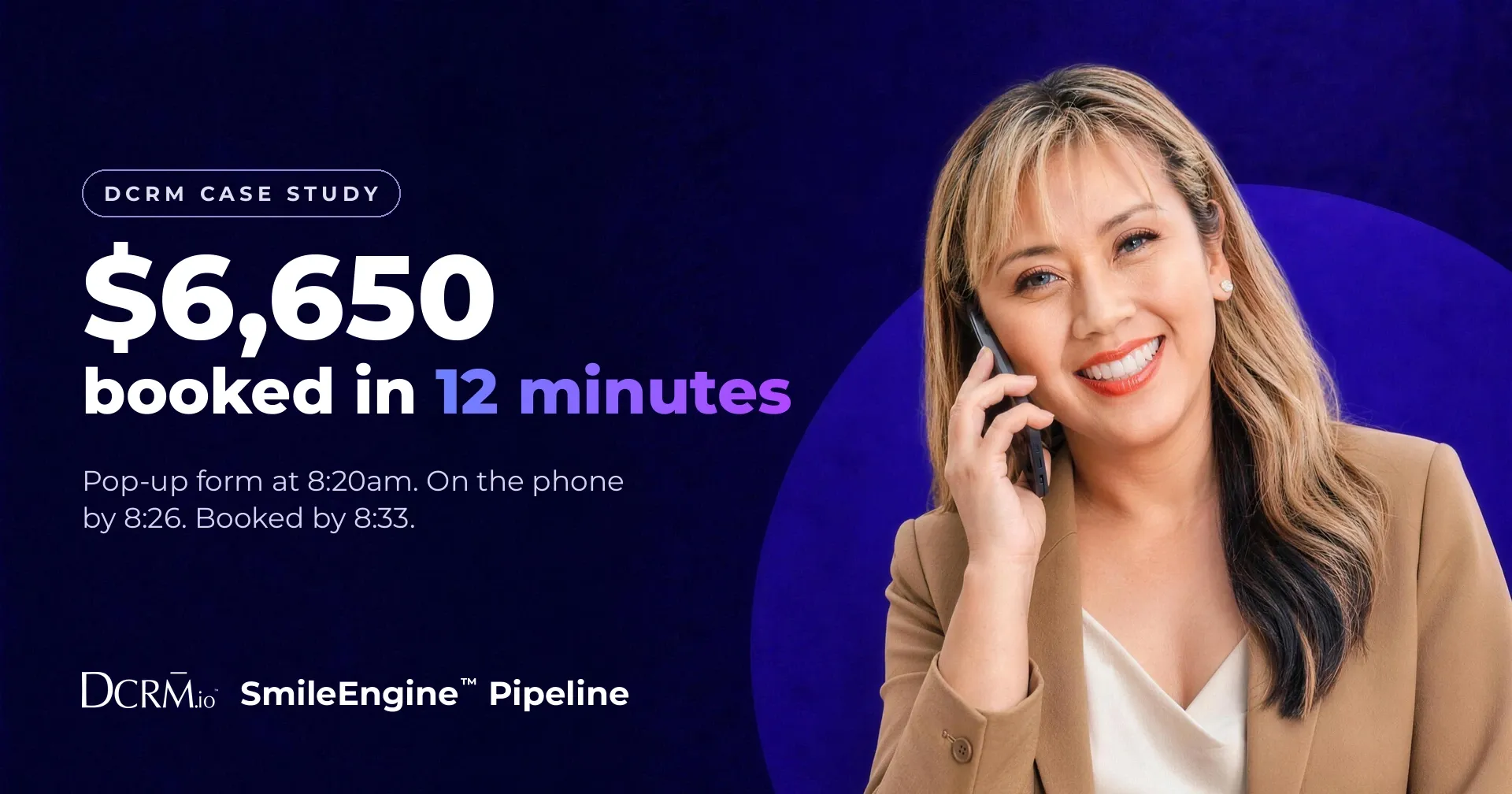
Quick answer
How fast should a dental practice call back a web enquiry?
While the patient’s window is still open. One practice rang an Invisalign enquiry 5 minutes after the pop-up form landed, and the case was booked 12 minutes 52 seconds after the form. The patient worked shifts, and 8:20 in the morning was the window they had.
$6,650 of orthodontic work, booked 12 minutes and 52 seconds after a pop-up form was filled in on a Wednesday morning.
I have the full call recording for this one, and the most interesting thing in it is a sentence the patient says about shift work.
The numbers
Every step below is stamped on the enquiry’s card in the SmileEngine™ Pipeline.
- From the pop-up form to a booking
- 12minutes
- Until the automatic text went out
- 12seconds
- On the phone, roughly
- 4minutes
- Case value
- $6,650
- 8:20amPop-up form submitted, on the practice’s Invisalign page
- 8:21amAutomatic text sent, 12 seconds later
- 8:26amThe practice rang
- 8:33amBooked, after a call of roughly 4 minutes
The treatment was orthodontic: Invisalign.
What they wrote, and then what they said
The form, on the practice’s Invisalign page, at 8:20am:
“Possibly”. This is somebody who has not decided.
12 seconds later an SMS went out saying a call was coming, with a short video about the practice behind it. At 8:26 the coordinator rang, and this is what came back:
4 minutes, start to finish. A first week of August consultation, midmorning on the Thursday, with the health fund and the date of birth taken on the same call.
In plain English
“I do shift work” is the whole case study.
That sentence is the reason this person had not booked before. It is not cost and it is not fear, it is that ringing a dental practice during business hours is difficult when you are asleep or on shift. They filled in a form at 8:20 in the morning because that was a window they had.
The practice rang back inside 6 minutes, while that window was still open. Ring at 2pm and they are asleep. Ring the next day and you are 1 of 3 practices they filled a form in for.
Frequently asked questions
Was the speed-to-lead call made by an AI?
No. It was an outbound call from the practice, answered and handled by a person. Our own notes had this wrong and I have corrected it.
How long between the web form and the call?
5 minutes and 19 seconds. The text went out at 12 seconds.
Did the booking hold?
The consultation was booked, then rescheduled twice in August, once because the patient had the time wrong. Both reschedules were handled on the phone.
Where does the $6,650 come from?
It is the value recorded on the orthodontic case. No price was quoted on the call.
Do we need call recording for this to work?
No, but without it you lose the detail. “I do shift work” is the most useful thing anyone said and it only exists because the call was recorded.

Written by
Liza Choa
Liza Choa is the founder of DCRM and Practice Growth Studio, a boutique dental marketing agency working behind the scenes with some of the most respected dental practices in Australia. She has spent over a decade helping practices grow and scale.
She built DCRM after seeing the same problem in practice after practice. The enquiries were already there, but the new patient numbers did not reflect it. DCRM bridges that gap, so practices increase the return on the marketing they are already paying for.
Disclaimer: The figures in this case study reflect the results of one dental practice over a defined period, and were taken from that practice’s DCRM account at the date stated. The practice is not identified, and identifying details have been removed or generalised. Results vary between practices and depend on factors outside the platform, including enquiry volume, treatment mix, pricing, location, team capacity and how consistently the practice follows up. These figures are not a prediction, projection or guarantee of the results any other practice will achieve. Data is reported as recorded in the platform and has not been independently audited. No patient information is disclosed.